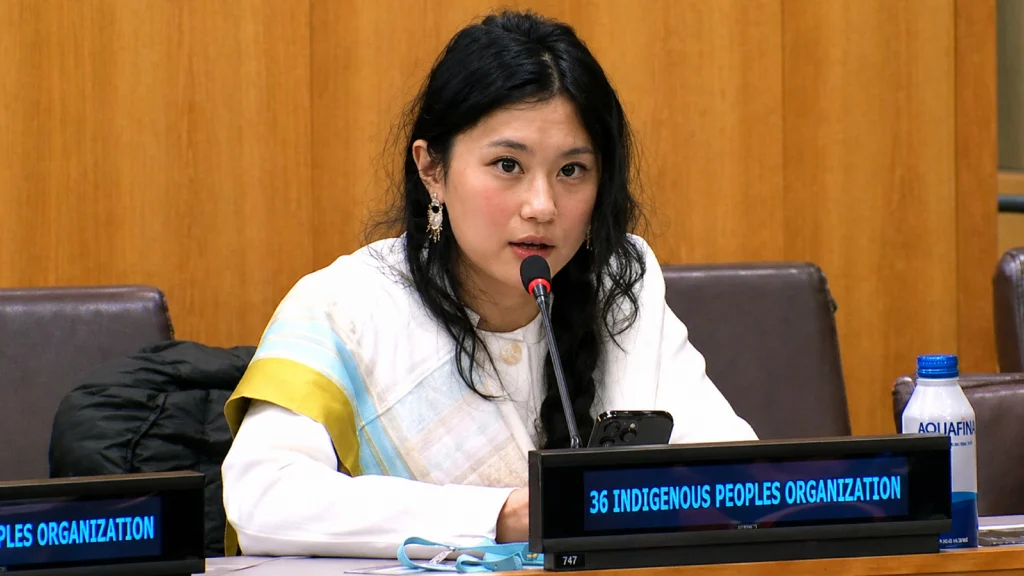
Hill Voice, 25 April 2026, International Desk: Representative of the Parbatya Chattagram Jana Samhati Samiti (PCJSS) Augustina Chakma has delivered her speech on Agenda Item 4: “Discussion on the six mandated areas of the Permanent Forum (economic and social development, culture, environment, education, health, and human rights), with reference to the United Nations Declaration on the Rights of Indigenous Peoples and the 2030 Agenda for Sustainable Development” on 24 April 2026 at around 4:48 pm (New York Time) at the 25th session of the United Nations Permanent Forum on Indigenous Issues (UNPFII).
On the same day, Tony Chiran, President of Bangladesh Indigenous Youth Forum (BIYF) has also delivered his speech on the same theme.
The 25th session of the UNPFII has started at the UN headquarters in New York on 20 April 2026 and will end on 1 May 2026.
Three representatives of the PCJSS, namely, Chanchana Chakma, Augustina Chakma and Priti Bindu Chakma, are attending the session while Pallab Chakma, Secretary General of AIPP, Dr. Binota Moy Dhamai of the Expert Mechanism on the Rights of Indigenous Peoples (EMRIP) and Toni Chiran of BIYF are also attending the session on behalf of indigenous peoples of Bangladesh.
In her statement, Augustina Chakma said:
“We have standards.
We have commitments.
We have the CHT Accord.
What we do not have is implementation.
In the Chittagong Hill Tracts, nearly three decades later, these commitments remain unfulfilled.
Instead of implementation, there has been militarization and repression. Indigenous organizations and individuals advocating for the Accord, including PCJSS, continue to be labelled as “terrorists” or “separatists,” contributing to their criminalization and exposure to arrest and harassment.
These practices continue – without consequence.
In 2025 alone, there were 268 documented incidents of human rights violations, affecting 606 Jumma people, including women and children.
These violations were not isolated.
They were carried out by multiple actors.
By security and law enforcement forces deployed in the Chittagong Hill Tracts.
By army-backed armed groups.
By communal and fundamentalist elements, including Rohingya armed militants.
By Bengali settlers and land grabbers.
At the same time, military patrol operations were conducted in 193 Jumma-inhabited villages, further contributing to an environment of fear and insecurity.
No perpetrators have been brought to justice.
These violations are not only human rights concerns.
They directly impact economic and social development, restrict access to education and healthcare, and undermine the cultural survival of the Jumma people.
Impunity is not an oversight; it is a pattern.
And this is not new.
This is a continuing reality.
Regardless of which government is in power, the CHT issue remains largely entrusted to the military. On March 12, the Home Minister stated that scrutinizing human rights violations would limit the actions of defence forces.
This reflects a position where accountability is not prioritized.
So, this is not a lack of standards.
It is a lack of accountability.
Without implementation, rights remain words on paper.
Commitments that are not implemented do not protect people.
I therefore urge the Permanent Forum to press for a policy of zero tolerance toward human rights violations in the Chittagong Hill Tracts, and to call for concrete steps toward full implementation of the Accord.”