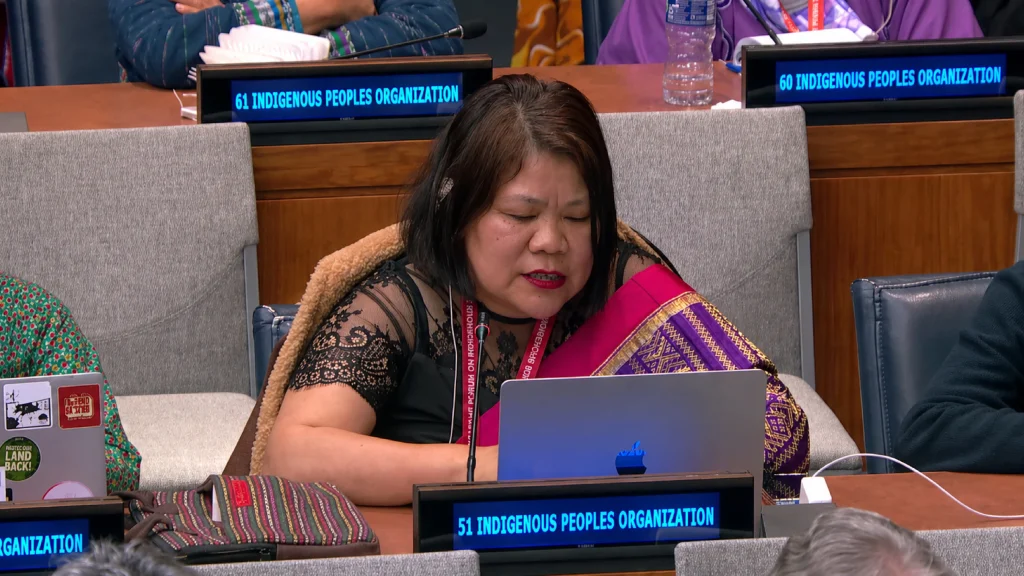
Hill Voice, 28 April 2026, International Desk: Representative of the Parbatya Chattagram Jana Samhati Samiti (PCJSS) Chanchana Chakma has delivered her speech on agenda item 5(g): “Thematic dialogue on the financing of Indigenous Peoples’ work and participation across the multilateral and regional system” on 28 April 2026 at 11:50 am (New York Time) at the 25th session of the United Nations Permanent Forum on Indigenous Issues (UNPFII).
The 25th session of the UNPFII has started at the UN headquarters in New York on 20 April 2026 and will end on 1 May 2026.
Besides, three representatives of the PCJSS, namely, Chanchana Chakma, Augustina Chakma and Priti Bindu Chakma, are attending the session while Pallab Chakma, Secretary General of AIPP and Dr. Binota Moy Dhamai of the Expert Mechanism on the Rights of Indigenous Peoples (EMRIP) are also attending the session on behalf of indigenous peoples of Bangladesh.
In her statement, Chanchana Chakma said “After the CHT Accord in 1997, the Bangladesh Government has initiated many projects to develop the Indigenous inhabited Chittagong Hill Tracts in Bangladesh. Many NGOs have also been encouraged to take part in the development.
One project is the construction of a border road along India and Myanmar and connecting roads in the CHT through the military due to which plantations and houses are destroyed and eviction of the Jumma people takes place. The military carry out projects without the Free, Prior and Informed Consent (FPIC) of indigenous peoples and no compensation is being provided by the government to the Indigenous families.
Besides road construction, also tourism projects by the military, outsiders and influential individuals have a negative impact on the Indigenous peoples.
Local NGOs took interest to carry out developmental activities after the CHT Accord, but their interest faded away with the restrictions imposed by the government. Foreign donors or foreigners are not allowed to visit the CHT without prior permission and once they are allowed to enter the CHT, the security forces are always on the tail of the foreigners. The local NGOs cannot have fund on human rights and other NGOs can only have funds after the DGFI or Directorate General of Forces Intelligence’s approval. This DGFI carries out heinous activities in the CHT.
Here I would like to mention with very disappointment that the Bengali settlers with the backing of the military in Bangladesh are now on the street to protest against what we, the Indigenous team from Bangladesh is saying in this 25th UNPFII. As the Bangladesh government is not taking any step to contain the protest rally by the Bengali settlers, it is an inability or partiality of the government. Indigenous peoples have rights to speak in the UNPFII.”
In conclusion, she put following some recommendations through the UNPFII to the Bangladesh Government:
The new Bangladesh Government will come forward to facilitate the development activities in the CHT by the civilians, not the military and with FPIC for a better Bangladesh.
1. Foreigners or donors must be allowed to enter the CHT for their aids.
2. Local NGOs must be encouraged for their participation in developmental activities and the CHT Accord be implemented fully so that the NGOs can be supervised by the Regional Council
3. The Bangladesh government should act to let the civilians know that Indigenous people have rights to speak in UNPFII.