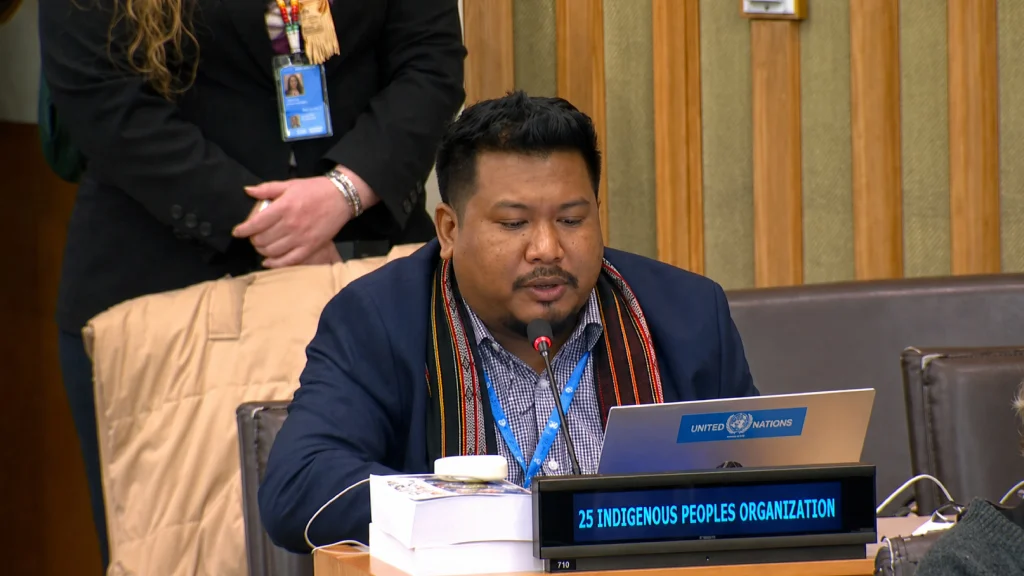
Hill Voice, 25 April 2026, International Desk: Tony Chiran, President of Bangladesh Indigenous Youth Forum (BIYF) has delivered his speech on Agenda Item 4: “Discussion on the six mandated areas of the Permanent Forum (economic and social development, culture, environment, education, health, and human rights), with reference to the United Nations Declaration on the Rights of Indigenous Peoples and the 2030 Agenda for Sustainable Development” on 24 April 2026 at around 12:45 pm (New York Time) at the 25th session of the United Nations Permanent Forum on Indigenous Issues (UNPFII).
The 25th session of the UNPFII has started at the UN headquarters in New York on 20 April 2026 and will end on 1 May 2026.
Besides, three representatives of the PCJSS, namely, Chanchana Chakma, Augustina Chakma and Priti Bindu Chakma, are attending the session while Pallab Chakma, Secretary General of AIPP and Dr. Binota Moy Dhamai of the Expert Mechanism on the Rights of Indigenous Peoples (EMRIP) are also attending the session on behalf of indigenous peoples of Bangladesh.
In his statement, Tony Chiran said, “We commend the Permanent Forum for its timely and comprehensive study on the impacts of colonisation and armed conflict on Indigenous Peoples’ rights. This work is an important step toward accountability and justice.
We also acknowledge the efforts of the newly elected Government of Bangladesh to advance Indigenous women’s participation in the decision-making process, including the reserved seats for women in the Parliament. This is a positive step toward inclusive governance and should be permanently reserved and ensured through meaningful consultation with the Indigenous peoples. However, in both the Chittagong Hill Tracts and the plains of Bangladesh, Indigenous Peoples face continuous systemic discrimination, land dispossession, violence, harassment, killing, rape, marginalisation, and violations of their fundamental rights, where access to justice is very limited.
Madam Chair, Two-thirds of the IPs living in the plain areas experience continuous land grabbing, violence, forced evictions, and a lack of legal recognition and negligence of their identities and customary land rights. But no effective enforcement, laws & policies, divisions or ministry, and only a few cultural institutions with very limited capacity to protect the rights of plain land Indigenous peoples. Besides, in the Chittagong Hill Tracts, ongoing militarisation and the incomplete implementation of the CHT Accord (1997) continue to fuel insecurity and mistrust. These challenges cut across all six mandated areas. Without land rights, economic development is unattainable. Displacement erodes Indigenous Peoples’ cultural identity, and environmental degradation increases when Indigenous stewardship is ignored. Barriers persist in accessing culturally appropriate education and healthcare. Human rights violations against IPs continue, often without accountability.
These realities contradict the United Nations Declaration on the Rights of Indigenous Peoples (UNDRIP), particularly the rights to self-determination, free, prior, and informed consent, and control over lands and resources. They also undermine the 2030 Agenda’s commitment to leave no one behind.
We therefore recommend and urge the Bangladesh Government and UNPFII,
- Establish a separate land commission and a dedicated ministry to protect customary land rights and the development for the Indigenous Peoples of the plains, and for the full, time-bound implementation of the CHT Accord, including effective land dispute resolution.
- Take steps toward the demilitarisation of the Chittagong Hill Tracts and stop development aggression on Indigenous Peoples’ ancestral land both in the Plains and CHT.
- Establish strong mechanisms to prevent land grabbing, ensure restitution, and guarantee accountability for human rights violations, particularly against Indigenous youth, women, and girls.
- Ensure meaningful participation of Indigenous Peoples, especially women and youth, in decision-making processes.
- Invest in culturally appropriate education and healthcare services that are accessible and non-discriminatory.
- Strengthen collaboration between the Government, UN agencies, and Indigenous organisations to advance the Sustainable Development Goals and the implementation of the UN Declaration.”