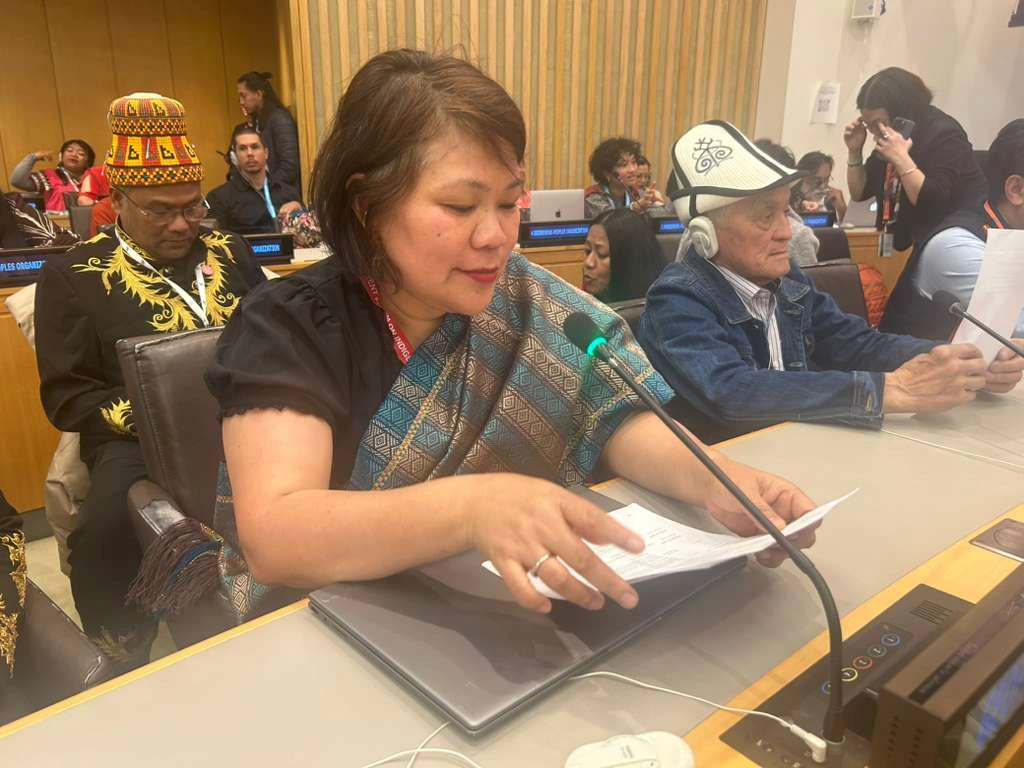
Hill Voice, 21 April 2026, International Desk: Representative of the Parbatya Chattagram Jana Samhati Samiti (PCJSS) Chanchana Chakma has delivered her speech on agenda item 5(e): Interregional, intergenerational and global dialogue on theme: “Indigenous Peoples and climate change: Articles 3, 4, 25 and 26 of the United Nations Declaration on the Rights of Indigenous P-Peoples” on 20 April 2026 at 5 pm (New York time) at the 25th session of the United Nations Permament Forum on Indigenous Issues (UNPFII).
The 25th session of the UNPFII has started at the UN headquarters in New York on 20 April 2026 and will end on 1 May 2026.
Three representatives of the PCJSS, namely, Chanchana Chakma, Augustina Chakma and Priti Bindu Chakma, are attending the session while Pallab Chakma, secretary general of AIPP, Binota Moy Dhamai of the Expert Mechanism on the Rights of Indigenous Peoples (EMRIP) and Toni Chiran of AIYP are also attending the session on behalf of Indigenous Peoples of Bangladesh.
In her statement, Chanchana Chakma said “Climate change has an adverse impact on the rights of Indigenous Peoples to their lands, forests, and hills. Conversely, the rights of Indigenous Peoples to their forests, lands, and hills are deeply intertwined with their right to self-determination. In the Chittagong Hill Tracts or CHT of Bangladesh, activities such as the construction of border roads, the indiscriminate extraction of stones from streams and waterfalls for road construction, the indiscriminate establishment of tourism centers on encroached lands by the military and outsiders, and the destruction of natural forests to create monoculture plantations are resulting in the destruction of ecological balance and biodiversity, the displacement of local indigenous communities, and impediments to traditional Jum (shifting) cultivation.
During the construction of border roads, the Bangladesh Army are appropriating potential sites as well as they are planning for tourism development. For instance, in 2024, the 26th Engineering Construction Battalion evicted 23 Jumma families and obstructed 17 families from engaging in Jum cultivation in two Jumma villages namely, Gachbagan Para and Thum Para located in the Jurachari and Bilaichari areas in Rangamati district.
To stop appropriation and other issues that are detrimental to the CHT Indigenous Jumma people and in order to preserve the rights of the Indigenous Jumma people, the CHT Accord was signed between the Jumma people and the government in 1997. Pursuant to this Accord, provisions were made for the establishment of the CHT Regional Council and the three Hill District Councils, introducing a special administrative system in the region. Out of 72 provisions, some core provisions include the devolution of subjects such as general administration, law and order, police, land and land management, forests and environment, and the development of communication systems to these councils. However, it is a matter of deep regret that, despite the passage of 28 years since the signing of the Accord, these subjects have yet to be devolved to these councils.
Besides, all temporary camps and military rule have yet been withdrawn from the CHT. Furthermore, land disputes have not yet been resolved through the Land Commission. In a nutshell, the right to self-determination for the indigenous Jumma people, as well as indigenous rights over forests, land, and hills—have not yet been established in the CHT.”
As a submission to the Government of Bangladesh, she presented the following recommendations to the Permanent Forum:
1) To address climate change, the customary rights of the indigenous Jumma people over their land and natural resources must be addressed and protected;
2) Land disputes must be resolved, and land and property alienated from the indigenous Jumma people must be restored to them;
3) A time-bound action plan (roadmap) for the implementation of the CHT Accord must be declared.