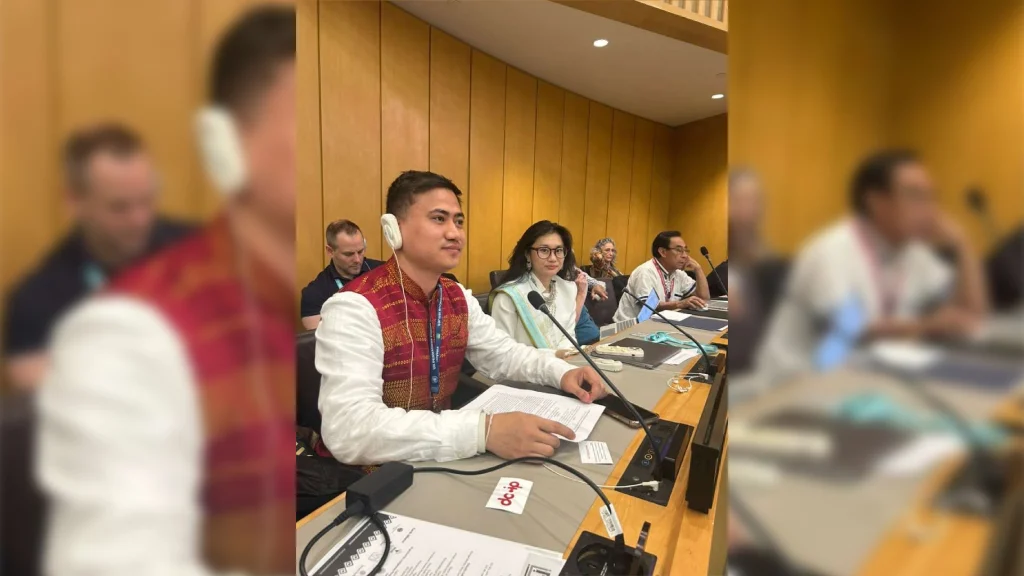
Hill Voice, 22 April 2026, International Desk: Representative of CHT Indigenous Peoples’ Council of Canada Khokan Chakma has delivered his speech on agenda item 5(d): “Human rights dialogue with the Special Rapporteur on the rights of Indigenous Peoples and the Expert Mechanism on the Rights of Indigenous Peoples; annual review progress on the implementation of general recommendation No. 39 (2022)” on 22 April 2026 at 11:45 am (New York Time) at the 25th session of the United Nations Permanent Forum on Indigenous Issues (UNPFII).
The 25th session of the UNPFII has started at the UN headquarters in New York on 20 April 2026 and will end on 1 May 2026.
Besides, three representatives of the PCJSS, namely, Chanchana Chakma, Augustina Chakma and Priti Bindu Chakma, are attending the session while Pallab Chakma, secretary general of AIPP, Binota Moy Dhamai of the Expert Mechanism on the Rights of Indigenous Peoples (EMRIP) and Toni Chiran of AIYP are also attending the session on behalf of indigenous peoples of Bangladesh.
In his statement, Khokan Chakma said, “It is very notable that the Indigenous rights have been outlined in the UN Declaration on the Rights of Indigenous peoples or UNDRIP and each and every Indigenous community in this universe should have all these rights for their existence and living as good human beings with dignity and respect.
The 97 CHT Accord or Chittagong Hill Tracts Accord is a testimony that there are Indigenous Jumma people in the Chittagong Hill Tracts, Bangladesh who deserve the rights with their ethnic background. But it is unfortunate that the previous Bangladesh Governments have not fulfilled this aspiration of Indigenous Jumma people with their dilly delaying tactics of full implementation of the Accord. Instead of preserving the Indigenous Jumma people with their rights, all governments who ruled the country in the past took a stance against the Jumma people: suppression and extinction. At the same time, their attitude is committing human rights violations and non-implementation of the Accord. The actor on behalf of the government is the Bangladesh military. Some examples could be cited as
1. As per the CHT Accord of provision 1, the CHT should be a tribe-inhabited region. It is interesting that the CHT is no more a tribe-inhabited region because more than 400,000 settlers were taken by the government and settled them there. Now there is continuation of settling of Bengalis from the plain districts and infiltration of Rohingya refugees and as result, the Jumma-Bengali ratio stands at 48:52.
2. The PCJSS or Parbabya Chattagram Jana Samhati Samiti, a signatory to the Accord, published a report on the human rights violations that took place in the CHT in 2025 and there were 268 incidents and out of which, 193 were committed by the Bangladesh military. The Indigenous women who are vulnerable in every country in the world have accounted 26 incidents as rape, molestation and harassment in the CHT in the report. It means the government does not take any measures to stop the violations against the Indigenous women.
3. Adivasi in Bengali and Indigenous in English is not acceptable to the military and the government and they think that it cannot be used in Bangladesh as the UN definition fearing that the Indigenous people can have more rights than the Bengalis and separation from the country may occur in future.”
To the end, he made the following recommendations:
1. Dr. Albert K. Barume was appointed as the UN Special Rapporteur on the rights of Indigenous Peoples in December 2024. We greet him warmly. Dr. Barume must visit the CHT once for his knowledge, experience and observation of overall CHT situation.
2. A new government has been formed in Bangladesh which may realize that preservation of Indigenous culture and tradition with their rights is not a separation, it is a development and humanity.