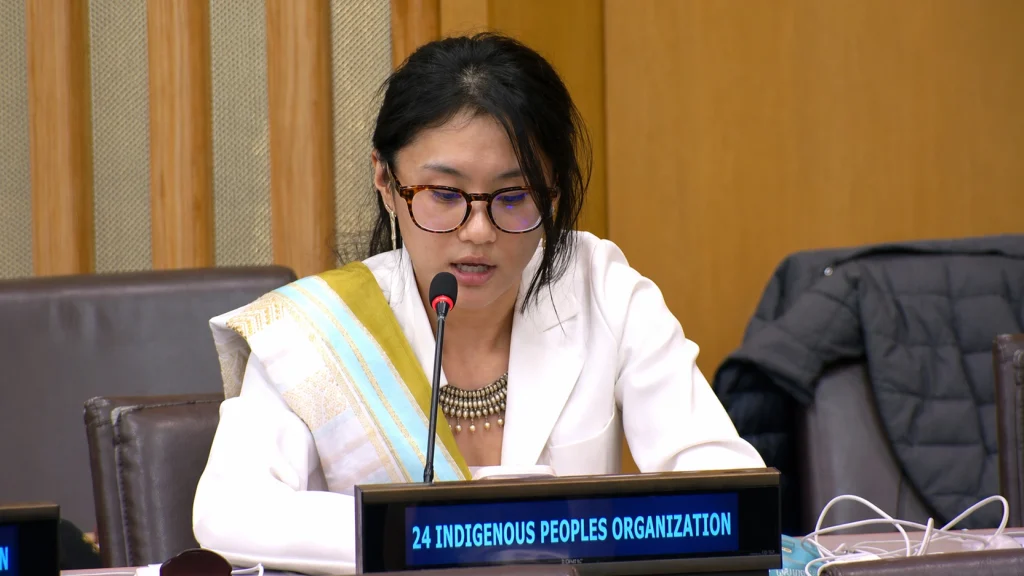
Hill Voice, 23 April 2026, International Desk: Representative of the Parbatya Chattagram Jana Samhati Samiti (PCJSS) Augustina Chakma has delivered her speech on agenda item 5(d): “Human rights dialogue with the Special Rapporteur on the rights of Indigenous Peoples and the Expert Mechanism on the Rights of Indigenous Peoples; annual review of progress on the implementation of general recommendation No. 39 (2022)” on 22 April 2026 at 5:54 pm (New York Time) at the 25th session of the United Nations Permanent Forum on Indigenous Issues (UNPFII).
On the same day, in the morning session, representative of CHT Indigenous Peoples’ Council of Canada Khokan Chakma has also delivered his speech on human rights of the Indigenous Peoples.
The 25th session of the UNPFII has started at the UN headquarters in New York on 20 April 2026 and will end on 1 May 2026.
Three representatives of the PCJSS, namely, Chanchana Chakma, Augustina Chakma and Priti Bindu Chakma, are attending the session while Pallab Chakma, Secretary General of AIPP, Dr. Binota Moy Dhamai of the Expert Mechanism on the Rights of Indigenous Peoples (EMRIP) and Toni Chiran of AIYP are also attending the session on behalf of indigenous peoples of Bangladesh.
In her statement, Augustina Chakma said, “In the Chittagong Hill Tracts (CHT), Jumma women and children wake up each day not knowing if they will survive the next assault. The promises of self-determination, land ownership, and cultural preservation made in the 1997 CHT Accord have been shattered, leaving them to face daily violence and dispossession.
In 2025, 26 violent incidents occurred: rape, abduction, and murder. A 12-year-old girl was gang-raped in Khagrachari, and when the Jumma community protested, their homes were burned. On May 5, 2025, a Khiyang housewife was raped and murdered by Bengali labourers, yet no accountability has been taken.
These are not isolated incidents; they are part of an ongoing pattern. Jumma women and children continue to face impunity, violence, and displacement. Despite the UNDRIP and CEDAW General Recommendation 39, these rights are still ignored.
How long will this continue? How many more women and children must endure these horrors without protection and accountability? We, the Jumma people, have been waiting for change – waiting for the CHT Accord’s promises to be honoured.
We cannot afford to keep repeating this cycle, asking for the same things year after year: protection, justice, and change, with no real progress.”
She made call on the Forum to:
1. Strengthen the UN Special Rapporteur’s mandate to investigate gender-based violence in the CHT region, ensuring real-time fact-finding and accountability.
2. Establish an independent international body to monitor ongoing violence and ensure justice for Jumma women and children.
3. Mobilize international pressure through NGOs and human rights organizations to hold Bangladesh accountable for its failure to protect Jumma women and children and implement the CHT Accord.
4. Ensure protection and support for human rights defenders, especially women advocates, who risk their lives for justice in the CHT regions.
5. Implement comprehensive support programs for survivors of sexual violence, including medical care, psychosocial support, and legal assistance to help them rebuild their lives.”
In conclusion, she said, “This is not just a matter of policy; it is a moral obligation. For the Jumma people, the promise remains: another year of broken vows. Without action, more women and youths will perish, and more communities will be lost.”