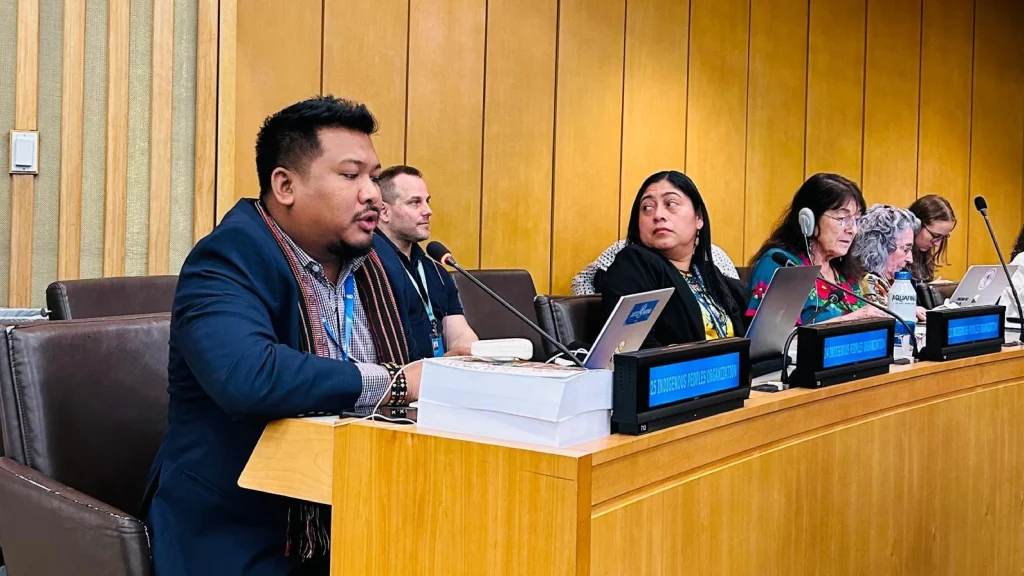
Hill Voice, 23 April 2026, International Desk: Tony Chiran, President of Bangladesh Indigenous Youth Forum (BIYF) has delivered his speech on agenda item 5(d): “Human rights dialogue with the Special Rapporteur on the rights of Indigenous Peoples and the Expert Mechanism on the Rights of Indigenous Peoples; annual review of progress on the implementation of general recommendation No. 39 (2022)” on 22 April 2026 at 5:54 pm (New York Time) at the 25th session of the United Nations Permanent Forum on Indigenous Issues (UNPFII).
The 25th session of the UNPFII has started at the UN headquarters in New York on 20 April 2026 and will end on 1 May 2026.
Besides, three representatives of the PCJSS, namely, Chanchana Chakma, Augustina Chakma and Priti Bindu Chakma, are attending the session while Pallab Chakma, Secretary General of BIYF and Dr. Binota Moy Dhamai of the Expert Mechanism on the Rights of Indigenous Peoples (EMRIP) are also attending the session on behalf of indigenous peoples of Bangladesh.
In his statement, Tony Chiran said, “In Bangladesh, both in the plains and in the Chittagong Hill Tracts (CHT), the rights to land, territories, and resources remain systematically denied. This ongoing dispossession is the root cause of violence, development aggression, militarization, displacement, and insecurity, which in turn profoundly impacts the physical, mental, and cultural well-being of Indigenous communities.
The prolonged failure to fully implement the CHT Accord continues to sustain a climate of militarization, communal attacks, killing, and instability. This severely restricts access to essential services, including healthcare, and undermines trust, safety, and dignity. In the plains, Indigenous communities face land grabbing, forced evictions, and harassment, often in a context of impunity. Recent incidents illustrate this alarming trend. On 9 March 2026, in Madhupur, Tangail of Plainland, Indigenous women, children, and youth were subjected to harassment and violence by security forces and eco-tourism and recreational lake on the IPs’ ancestral land by the Forest Department. In Gobindaganj, Gaibandha, Santal Indigenous women were brutally attacked by land grabbers. Similarly, in the greater regions, the traditional Jum cultivation lands of the Khasi, Garo, and other Indigenous Peoples are being destroyed. These violations not only threaten lives and safety but also disrupt access to traditional food systems, medicines, and healing practices, endangering cultural survival.
Indigenous women, girls, and persons with disabilities face intersecting and compounded forms of discrimination and violence in these contexts. General Recommendation No. 39 rightly emphasizes that such intersecting inequalities directly affect Indigenous women’s health, autonomy, and well-being. Indigenous persons with disabilities remain particularly at risk during conflict and displacement, often excluded from emergency responses and left in unsafe conditions.
Structural barriers continue to limit access to culturally appropriate healthcare. Indigenous health systems, including traditional healers and knowledge holders, remain largely unrecognized and unsupported. Yet, for Indigenous Peoples, health is inseparable from land, identity, culture, and self-determination.”
Finally, in this regard, He called on States and the United Nations to:
Urge the Government of Bangladesh to fully implement the CHT Accord, including demilitarization, land rights restitution, and the effective functioning of the Land Commission, and to establish a dedicated Ministry for Indigenous Peoples in the plains.
Develop and implement National Action Plans in line with CEDAW General Recommendation No. 39, with the full and effective participation of Indigenous women, including those with disabilities.
We urge the Permanent Forum to recommend that Member States, together with Indigenous Peoples, seek an ICJ advisory opinion on States’ obligations under UNDRIP regarding self-determination, lands, territories, and FPIC.
Strengthen engagement with the Special Rapporteur and the Expert Mechanism to monitor and report on human rights violations against Indigenous Peoples in Bangladesh.
Encourage the United Nations system to enhance coordination, including with peacebuilding actors, to support the implementation of agreements affecting Indigenous Peoples.
Urge States to implement UNDRIP and CRPD provisions ensuring access to culturally appropriate, rights-based healthcare, including mental health services.
Recognize and support Indigenous health systems, including traditional medicine, healers, and midwives.
Ensure the inclusion of Indigenous territorial data in all health, development, and humanitarian frameworks to address invisibility and exclusion.