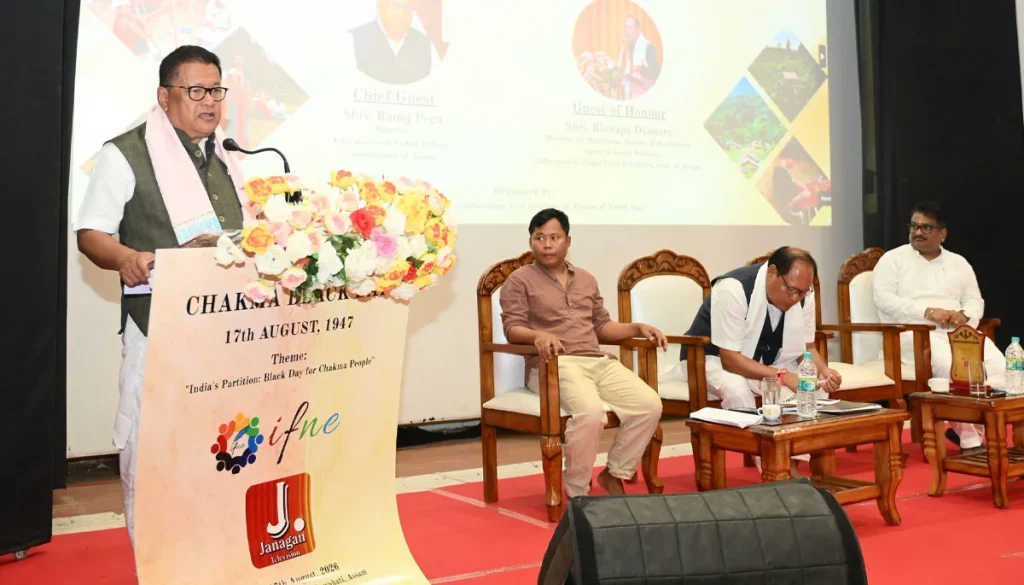
Hill Voice, 17 August 2026, International Desk: 17 August Observed as “Black Day‟ for Chakma Peoples; Speakers Call for Greater Attention to CHT, Indigenous Rights and Northeast India’s Geopolitical Future Guwahati, 17 August 2026.
17 August was observed as a “Black Day” for the Chakma Peoples and the Indigenous Peoples of the Chittagong Hill Tracts (CHT) at a public programme held today at the PWD Auditorium, Guwahati, Assam. The programme was organised under the theme “India‟s Partition: Black Day for Chakma People.
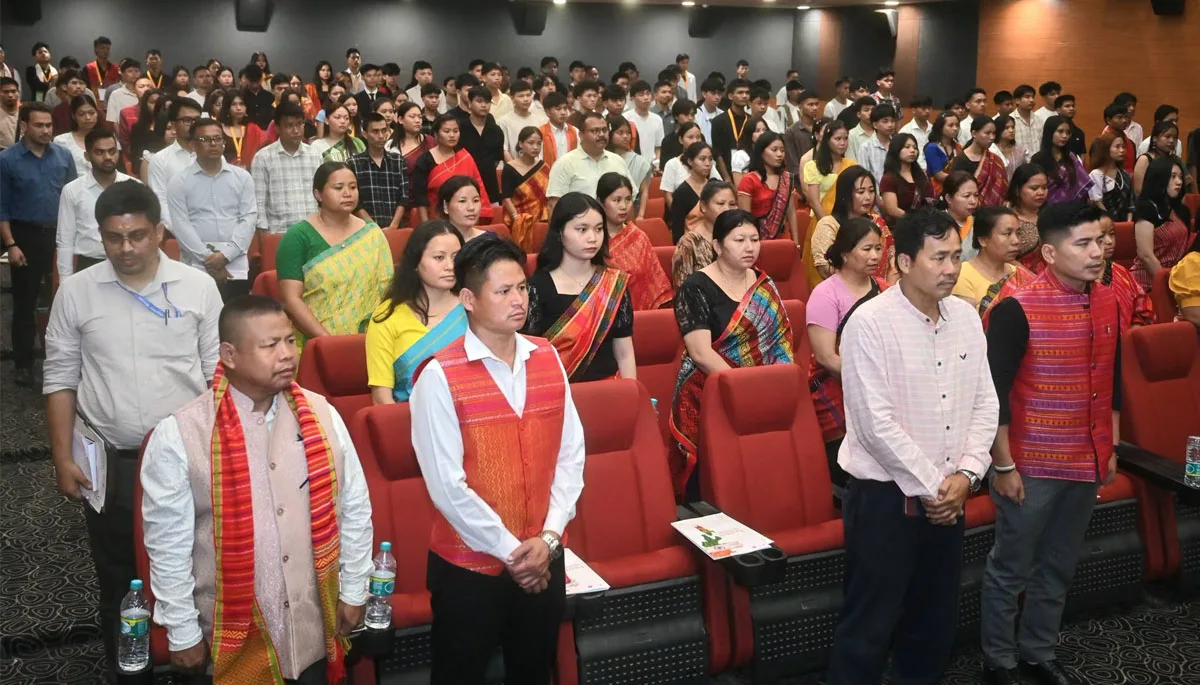
The programme brought together public representatives, researchers, Indigenous community leaders, students, intellectuals, writers and members of civil society to remember the publication of the Radcliffe Award on 17 August 1947, which placed the Chittagong Hill Tracts under Pakistan despite its overwhelmingly Indigenous and non-Muslim population at the time. The organisers described the decision as a defining historical turning point that continues to shape the political geography, demographic transformation, land relations and security environment of the CHT and Northeast India.
The 1997 CHT Accord was also discussed as an important framework for addressing the political, institutional and land-related questions of the region.
While acknowledging the Accord as a historic achievement that ended the major phase of armed insurgency, the programme stressed the distinction between signing an agreement and implementing it. The speech notes argued that the CHT requires effective implementation of the existing Accord and functioning of the institutions established under it.
A central message of the programme was that the CHT question cannot be viewed solely as an internal issue of Bangladesh.
The CHT lies immediately alongside India’s Northeast, particularly Tripura and Mizoram, while also occupying a strategic position between India, Bangladesh and Myanmar. Chattogram, Bangladesh’s principal maritime gateway, lies immediately beyond the CHT. The programme therefore described the CHT as a “geopolitical hinge” connecting the Bay of Bengal, Chattogram, the CHT, Northeast India, Myanmar and Southeast Asia.
The programme further discussed the importance of Chattogram and Mongla ports for India’s Northeast connectivity. India and Bangladesh established an SOP in 2019 for the movement of Indian goods through these ports, creating an alternative logistical route to the Northeast through Bangladesh.
The discussion consequently emphasised that connectivity is both an opportunity and a strategic dependency, making political stability, border security and territorial stability in the wider CHT– Chattogram environment important considerations for Northeast India.
The programme also examined the changing strategic environment involving India, Bangladesh, Pakistan, China and Myanmar, and the implications of developments in the Bay of Bengal and Southeast Asia.
The discussion did not portray Bangladesh as a proxy of any external power, but stressed that India’s eastern strategic environment is becoming increasingly complex and that developments in the CHT have implications beyond the territory itself.
The opening speech was delivered by Dr. Shyamal Bikash Chakma, Researcher and Director, CTRA. He stated that, “the CHT issue is not only an issue for the people of the CHT. It also has implications for Northeast India and, ultimately, India’s national interest, security, sovereignty and territorial integrity. India played a vital role in the political history of Bangladesh and the CHT 1997 Accord.”
Shri Ranoj Pegu, Minister, Education and Tribal Affairs, Government of Assam, the Chief Guest of the programme stated that, “He stands with the Chakma community and other Indigenous Peoples of CHT against the historical injustice meted out to them by the awarding the CHT to Pakistan despite representing more than 97% of non-Muslims in the CHT by the British colonial administrators in 1947. However, same mistake again committed in 1971 by ignoring the people of CHT and their aspiration to be part of India. He asserted that another opportunity will to rectify these historical mistakes repeatedly.”
Shri Biswajit Daimary, Minister for Handloom, Textiles & Sericulture, Sports & Youth Welfare, Indigenous & Tribal Faith & Culture, Government of Assam, Guest of Honour of the Programme stated that the “17th August is very important, not only for the Chakmas and Indigenous Peoples of CHT but also for the people of India to know what really happened in CHT in 1947 – the historical injustice, oppression and suffering due to the eleven hour decision to award the CHT to Pakistan. He also asserted that he will do his best to works for the welfare of the Chakma community.
Shri Swapnil Kashyab, President of Intellectual Forum of North East, stated that “the India’s partition led to genocide like situations that includes the CHT. The then Congress leaders acted on behalf of the Christian missionaries except Shyama Prasad Mukherjee and Dr. B.R Ambedkar who opposed and save India from becoming a Christian majority Indian state”. He further state that one day the lost lands of Bharat (India) including the CHT must be brought back and united with Bharat (India).
Smt. Mita Nath Bora, Member, Assam Youth Commission and Researcher has illustrated the historical injustice due to the deliberate and conscious repetition of series of mistakes which she term it a surgery that went horribly wrong by the most ineligible boundary commissioner led by Syril Radcliffe. She further stated that the rest of India still does not know the worst and horrible India’s partition exercises including the CHT. She stated that the CHT was never part of the Bengal Legislative Council and she questioned that how CHT’s geographical demarcation can be included in the terms of reference for the partition.
Dr. Ankita Dutta, Author and Columnist, highlighted the on-going atrocities against the non-Muslims minorities in the CHT which never gets highlighted in the national and international media. She further urged the present Indian government to consider sacting in order to prevent the ongoing genocide and atrocities backed by the Muslims fanatics against the minorities in Bangladesh, particularly the CHT.
The programme began with the arrival and reception of guests, ceremonial candle lighting, felicitation and an introduction to the programme. Dr. Shyamal Bikash Chakma, Director, CTRA, delivered the introduction to the programme. The schedule listed Shri Ranoj Pegu, Minister for Education and Tribal Affairs, Government of Assam, as Chief Guest and Shri Biswajit Daimary, Minister for Handloom, Textiles & Sericulture; Sports & Youth Welfare; Indigenous & Tribal Faith & Culture, Government of Assam, as Guest of Honour.
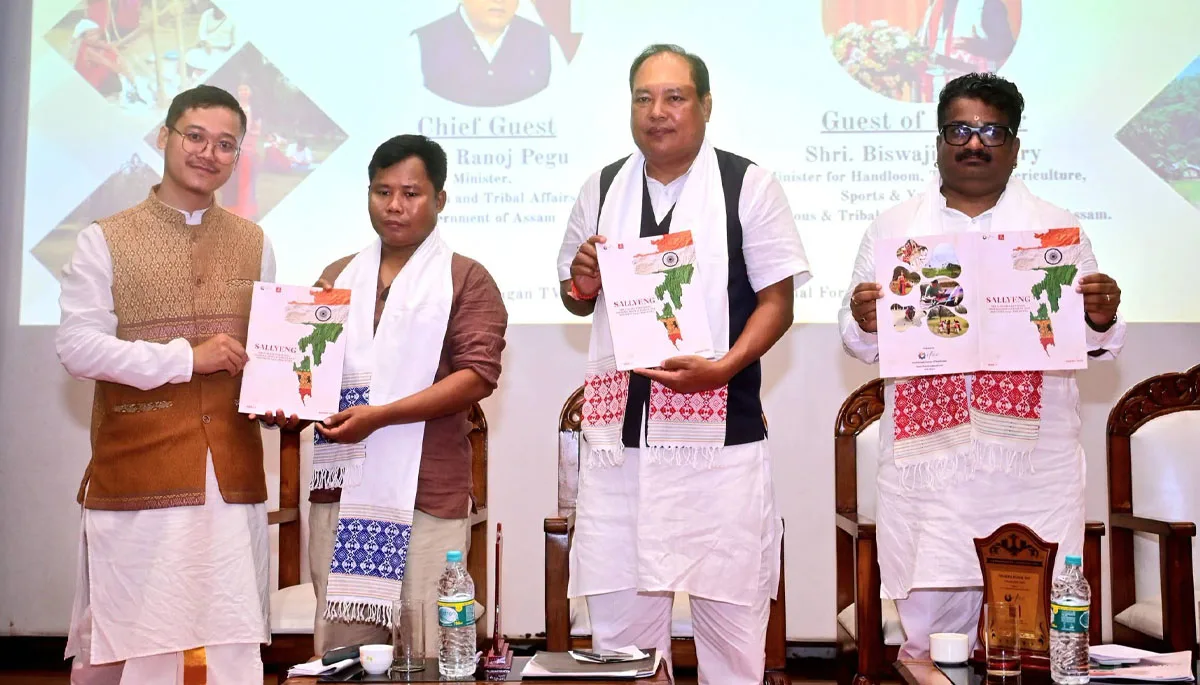
The programme also featured an address by Shri Rajarshi Neog, Vice President, Intellectual Forum of North East, the launch of the Janagan TV newsletter “Sallyeng”, and cultural presentations by members of the Chakma community. The afternoon session included addresses by Asutosh Chakma, President, All Assam Chakma Society, Smt. Mita Nath Bora, Member, Assam Youth Commission and Researcher, Dr. Ankita Dutta, Author and Columnist, Shri Drishya Muni Chakma, President, All India Chakma Students‟ Union, along with cultural performances and other speakers.
The event was held at the PWD Auditorium, Guwahati, and was organised by Janagan TV in collaboration with the Intellectual Forum of North East, with support from the Guwahati Chakma Students‟ Union (GCSU) and All Assam Chakma Society (AACS).