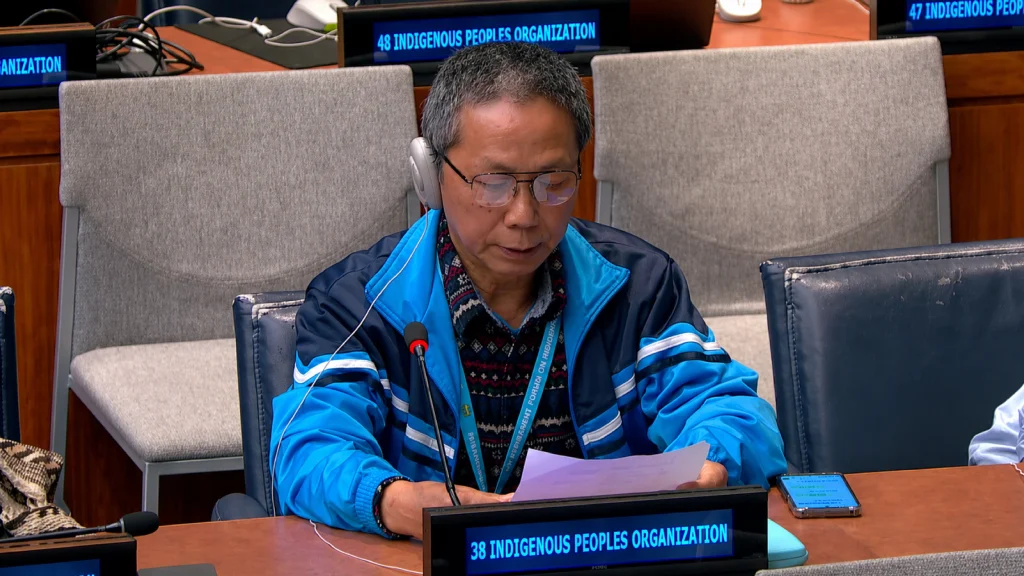
Hill Voice, 29 April 2026, International Desk: Representative of the Parbatya Chattagram Jana Samhati Samiti (PCJSS) Priti Bindu Chakma has delivered his speech on agenda item 6: “Future work of the Permanent Forum, including issues considered by the Economic and Social Council, the outcome document of the World Conference on Indigenous Peoples and emerging issues” on 29 April 2026 at the 25th session of the United Nations Permanent Forum on Indigenous Issues (UNPFII).
The 25th session of the UNPFII has started at the UN headquarters in New York on 20 April 2026 and will end on 1 May 2026.
Besides, three representatives of the PCJSS, namely, Chanchana Chakma, Augustina Chakma and Priti Bindu Chakma, are attending the session while Pallab Chakma, Secretary General of AIPP and Dr. Binota Moy Dhamai of the Expert Mechanism on the Rights of Indigenous Peoples (EMRIP) are also attending the session on behalf of indigenous peoples of Bangladesh.
In his statement, Priti Bindu Chakma said, “The Permanent Forum has done a lot for peace around the world with regard to the livelihood of the Indigenous peoples. If the ruling nations complied with the Permanent Forum’s initiatives, peace could have been prevailed in the areas or countries where Indigenous peoples inhabit and development would be a milestone for the betterment of life in that country. But unfortunately, most of the ruling nations don’t listen to it. They go in the opposite direction of the UN’s initiative. As a result, there are continued human rights violations in the Indigenous peoples’ populated areas in the world.
Bangladesh is one of many countries that commit human rights violations on the Indigenous peoples. It ratified ILO 107 in 1972 to protect the Tribals and Indigenous peoples in the country. Not only that, Bangladesh also signed an agreement called the CHT Accord with the CHT Indigenous peoples in 1997 as a limited autonomy. It is very regretting that both ratification and the Accord don’t work as all respective Bangladesh Governments have been indifferent in implementing them with their ill attitudes. Bangladesh could have become an exemplary model in preservation of Indigenous rights if ILO 107 and the Accord implemented fully.
As many governments are reluctant in recognizing the Indigenous peoples with their rights and rather carry out ethnic cleansing policy with human rights violations, the Permanent Forum could have taken some initiatives as its future works and these could be
1. Commitment of the State members of the UN to constitute the rights of the Indigenous peoples in their respective countries
2. Deployment of Peacekeeping forces in the areas or countries where Indigenous peoples have been heavily affected. It could be the CHT too.”